-
 Call Now ! +91-9105912123
 -
 Email Now kumaonmiet@gmail.com

05 Jun 2026
Every year, thousands of students complete their 12th with Physics, Chemistry, and Biology (PCB) and start exploring career opportunities in the healthcare sector. While many students prepare for MBBS and other medical programs, healthcare is much broader than becoming a doctor. Today's healthcare system depends on a large team of skilled professionals who contribute to patient care, diagnosis, treatment, and rehabilitation.
This is where Paramedical Science comes into the picture.
Paramedical courses prepare students for specialised healthcare careers that support doctors and healthcare institutions. These professionals play an important role in hospitals, diagnostic centres, rehabilitation clinics, laboratories, and medical imaging departments. With the growing healthcare infrastructure across India and Uttarakhand, paramedical careers are becoming increasingly popular among PCB students.
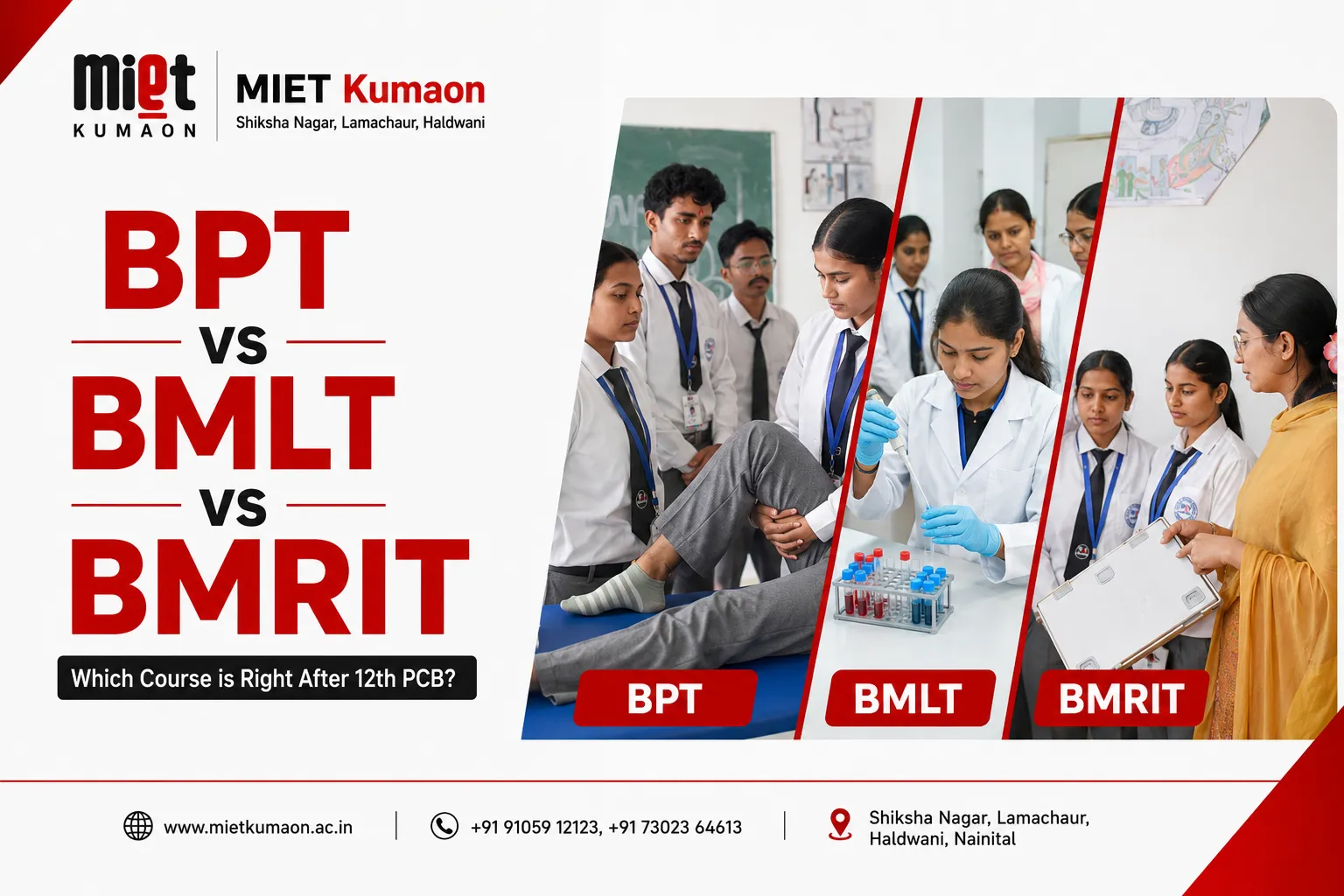
Among the most sought-after paramedical courses are the Bachelor of Physiotherapy (BPT), the Bachelor of Medical Laboratory Technology (BMLT), and the Bachelor of Medical Radiology and Imaging Technology (BMRIT).
BPT focuses on physical rehabilitation and helping patients recover from injuries, surgeries, and movement-related disorders. BMLT is centred around laboratory testing and disease diagnosis, where professionals perform medical tests that assist doctors in making treatment decisions. BMRIT focuses on advanced medical imaging technologies, including X-rays, MRI, CT, and ultrasound, to detect and diagnose various health conditions.
Although all three courses belong to the healthcare sector, they lead to very different career paths. Understanding the difference between BPT, BMLT & BMRIT can help students choose a course that aligns with their interests, skills, and long-term career goals.
In this guide, we will compare these three popular paramedical courses and help you determine which option may be the best fit after 12th PCB.
Allied Paramedical Courses are professional healthcare programs designed to train students in specialized areas of patient care, diagnostics, rehabilitation, and medical technology. These courses prepare healthcare professionals who work alongside doctors, nurses, and other medical experts to ensure quality healthcare services.
Modern hospitals and healthcare facilities rely heavily on paramedical professionals. From diagnosing diseases through laboratory tests to assisting patients with rehabilitation and operating advanced imaging equipment, paramedical professionals contribute significantly to the healthcare system.
Some of the most important allied paramedical professions include physiotherapists, medical laboratory technologists, radiology and imaging technologists, operation theatre technologists, and other healthcare specialists.
As healthcare services continue to expand across Uttarakhand and India, the demand for qualified paramedical professionals is growing rapidly. This makes allied paramedical courses an excellent choice for students who want to build rewarding careers in the healthcare sector.
Understanding BPT (Bachelor of Physiotherapy)
Bachelor of Physiotherapy (BPT) is a healthcare program focused on rehabilitation, movement science, and physical therapy. Physiotherapists help patients recover from injuries, surgeries, neurological disorders, sports injuries, and mobility-related problems.
Duration: 4 Years and 6 months
Eligibility: 10+2 with PCB/PCM with 50%
Physiotherapists work directly with patients in:
After completing BPT, graduates can work as:
Fresh graduates may start with competitive entry-level salaries, with significant growth opportunities based on experience, specialization, and practice.
BPT is ideal for students who:
BMLT focuses on laboratory diagnostics and medical testing. Medical laboratory professionals perform tests on blood, tissues, and body fluids that help doctors diagnose and treat diseases.
Duration: 3 Years and 6 months
Eligibility: 10+2 with PCB/PCM with 50%
BMLT professionals generally work in:
Graduates can work as:
The increasing demand for diagnostic services has created strong employment opportunities for laboratory professionals.
BMLT is suitable for students who:
BMRIT focuses on medical imaging technologies used for diagnosis and treatment planning. Students learn to operate sophisticated imaging equipment used in modern healthcare.
Duration: 3 Years and 6 months
Eligibility: 10+2 with PCB/PCM with 50%
BMRIT graduates commonly work in:
Career options include:
As hospitals increasingly invest in advanced imaging technology, the demand for radiology professionals continues to rise.
BMRIT is a good choice for students who:
Although BPT, BMLT, and BMRIT are all healthcare-related courses, they prepare students for very different roles within the healthcare system.
BPT focuses on rehabilitation, physical therapy, and helping patients recover from injuries, surgeries, and mobility-related conditions.
BMLT focuses on laboratory diagnostics. Students learn how to perform medical tests that help doctors diagnose diseases and monitor patient health.
BMRIT focuses on medical imaging and diagnostic technology. Students are trained to operate imaging equipment such as X-ray, MRI, CT Scan, and ultrasound machines.
Students who choose BPT usually work closely with patients every day. Physiotherapists spend a significant amount of time guiding patients through treatment and recovery programs.
In BMLT, direct patient interaction is comparatively limited because most work takes place inside laboratories.
BMRIT professionals interact with patients while conducting imaging procedures, but their patient interaction is generally less extensive than that of physiotherapists.
BPT graduates typically work in hospitals, physiotherapy clinics, rehabilitation centres, sports medicine facilities, and wellness centres.
BMLT graduates mainly work in pathology laboratories, diagnostic centres, hospitals, and research laboratories.
BMRIT graduates generally work in radiology departments, diagnostic imaging centres, hospitals, and specialized healthcare facilities.
Technology plays a role in all three fields, but the level varies.
BPT uses rehabilitation equipment and therapeutic technologies to support patient recovery.
BMLT relies on laboratory instruments and testing equipment to perform diagnostic procedures.
BMRIT involves extensive use of advanced imaging technologies such as MRI scanners, CT scanners, digital X-ray systems, and ultrasound equipment.
BPT graduates can pursue careers as physiotherapists, rehabilitation specialists, sports physiotherapists, and clinical practitioners.
BMLT graduates can work as laboratory technologists, pathology professionals, diagnostic specialists, and research assistants.
BMRIT graduates can build careers as radiology technologists, MRI technicians, CT scan technologists, and imaging specialists.
Students who complete BPT often pursue a Master of Physiotherapy (MPT) in specialized areas such as Orthopedics, Neurology, Sports Physiotherapy, or Cardiopulmonary Physiotherapy.
BMLT graduates may continue with postgraduate studies in Medical Laboratory Technology, Clinical Biochemistry, Microbiology, or related healthcare disciplines.
BMRIT graduates can pursue advanced studies in Radiology, Medical Imaging Technology, MRI Technology, or Healthcare Management.
There is no single answer because each course serves a different purpose in healthcare.
If you enjoy working directly with patients and helping them recover physically, BPT may be the right choice.
If laboratory science and disease diagnosis interest you, BMLT could be a better fit.
If you are fascinated by medical technology and imaging equipment, BMRIT may offer the career path you are looking for.
The best course is the one that matches your interests, strengths, and long-term career goals.
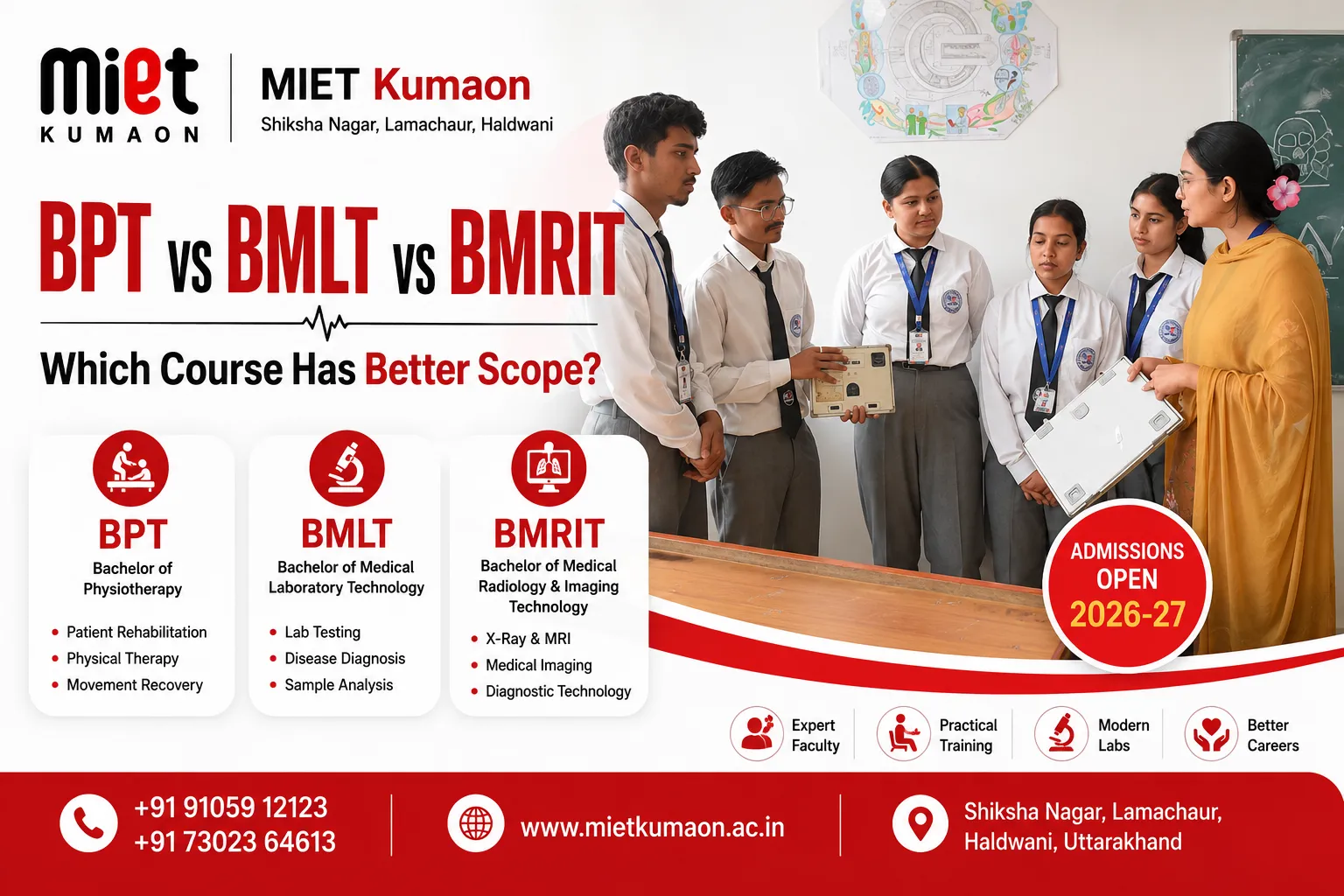
This is one of the most common questions asked by students.
The truth is that all three courses have strong career prospects. The best choice depends on your interests and strengths.
India's healthcare sector is expanding rapidly. New hospitals, diagnostic centers, specialty clinics, and wellness facilities are creating employment opportunities for allied healthcare professionals.
The growing need for accurate diagnosis has increased demand for both laboratory technologists and radiology professionals.
Physiotherapy services are becoming an essential part of healthcare, particularly in sports medicine, orthopedics, neurology, and post-surgical recovery.
Healthcare infrastructure is growing in cities such as Haldwani, Rudrapur, Dehradun, and other regions of Uttarakhand. This has increased the need for skilled healthcare professionals across multiple specialties.
Many students in Uttarakhand are now exploring allied healthcare programs because they offer a combination of professional education, practical skills, and promising career opportunities.
The healthcare industry requires more than doctors alone. Hospitals need physiotherapists, laboratory technologists, and radiology professionals to provide quality patient care.
With growing healthcare infrastructure and increasing awareness of specialized healthcare services, allied healthcare careers continue to offer long-term career stability.
When selecting a healthcare college, students should look beyond course names and evaluate factors such as faculty, practical training, laboratory facilities, clinical exposure, internship opportunities, and career support.
MIET Kumaon focuses on providing students with industry-oriented healthcare education through experienced faculty, practical learning environments, laboratory training, and skill development opportunities. The institution aims to prepare students for real-world healthcare careers by combining academic knowledge with professional exposure.
For students in Haldwani and surrounding regions, MIET Kumaon offers an accessible option for pursuing healthcare education closer to home.
Choosing between BPT, BMLT, and BMRIT can seem challenging at first, but the decision becomes easier when you understand the nature of each profession.
If you enjoy working closely with patients and helping them recover, BPT may be the right choice. If laboratory science and diagnostics interest you, BMLT can offer a rewarding career path. If you are fascinated by medical technology and imaging systems, BMRIT could be an excellent fit.
Rather than focusing on which course is "better," focus on which course aligns best with your interests, strengths, and long-term career goals. A successful healthcare career begins with choosing a field that genuinely excites you.
Find answers to common questions about Uttarakhand Board Result 2026.
Planning a career in nursing? Explore the GNM Nursing Course in Haldwani to lear...
Read More →
Planning to pursue BCA in Haldwani? Learn what students should check before enro...
Read More →
Short Description Discover how BCA students can build a successful AI career in...
Read More →
MIET Kumaon is a paramedical college in Haldwani offering career-focused program...
Read More →
Discover a nursing college in Haldwani that combines academic learning with prac...
Read More →Apply now to secure your future with world-class education, expert faculty, and industry-focused programs designed for success.